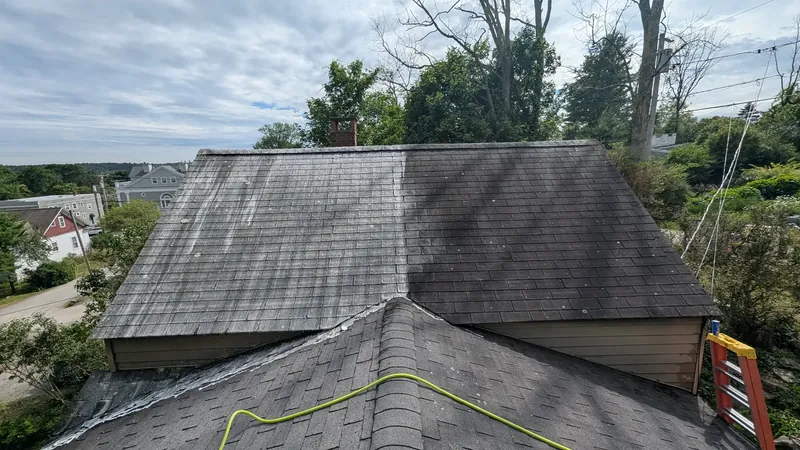
1. Dark streaks running down the roof
This is the most common sign, and it's the one most people notice first. Those dark gray or black streaks running vertically down your shingles aren't dirt or water staining — they're a living organism called Gloeocapsa Magma, an airborne algae that feeds on the limestone filler in asphalt shingles.
Once it establishes itself, it spreads. The streaks you see today cover a much larger colony than what's visible — the algae spreads as a biofilm across the surface of the shingles, and the dark streaking appears as the dead cells accumulate on the surface.
Left untreated, Gloeocapsa Magma accelerates the degradation of your shingles. It causes granule loss (the texture you feel on an asphalt shingle), which shortens the lifespan of the roof. Most roofing manufacturers now specifically state that algae growth is grounds for early replacement — and some warranties are voided if biological growth is allowed to persist.
Black streaks on an asphalt roof are not a cosmetic issue — they're a sign of active biological growth that's degrading your shingles. Soft washing removes it; pressure washing does not (and can damage the shingles).
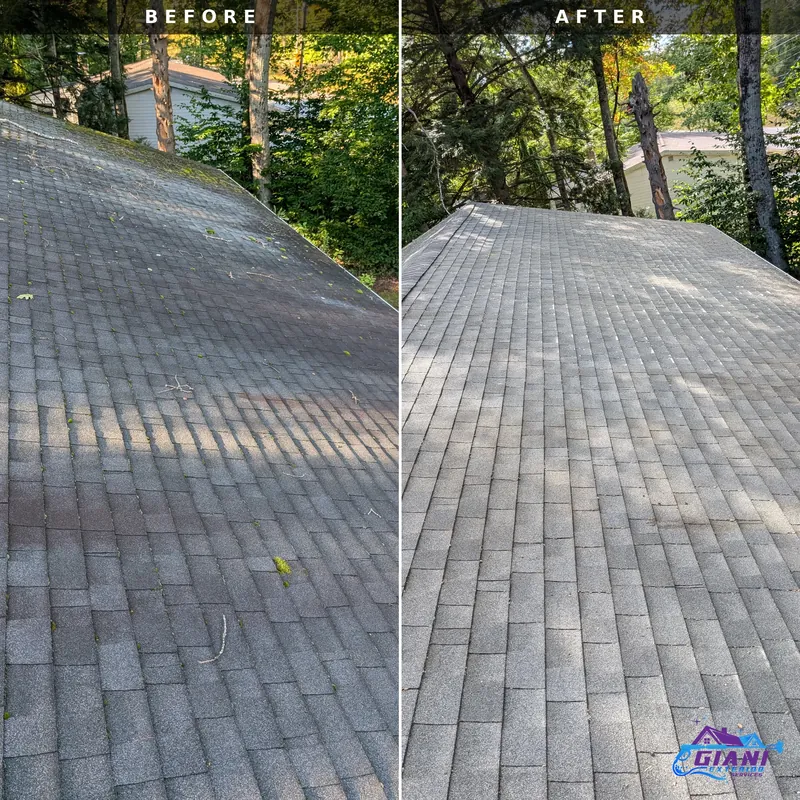
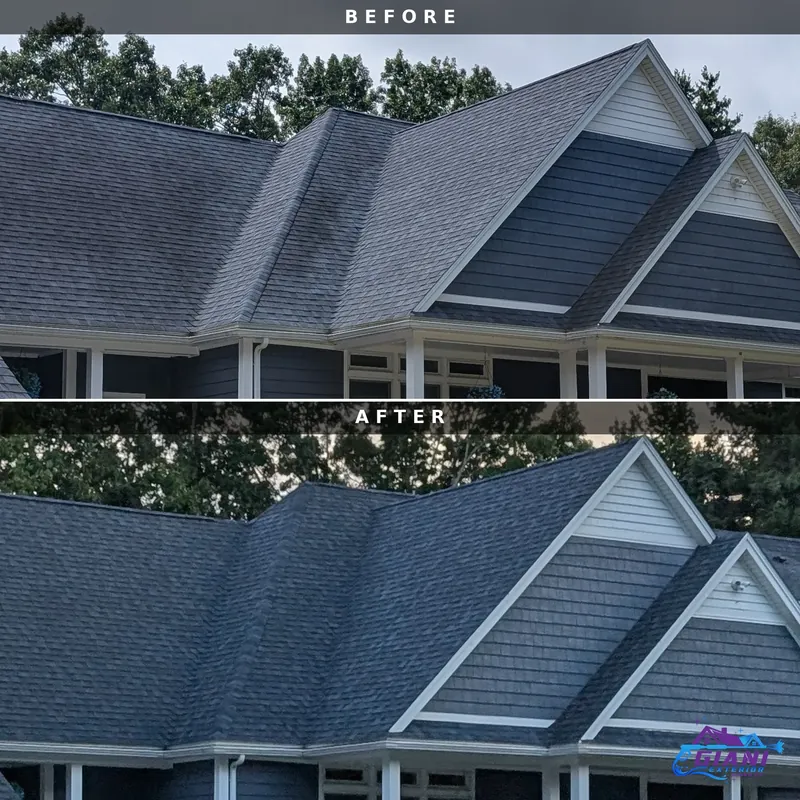
From our recent jobs
2. Green patches or a green tint to the roof
A green tint or scattered green patches on the roof surface is typically algae in an earlier, more active growth phase — or a combination of algae and mildew. It's especially common on north-facing roof sections and areas under heavy shade, where the roof stays damp longer after rain.
The distinction matters: green growth is usually easier to treat than the dark streaking, which represents a more established colony. If you're seeing green on your roof, the good news is that you're catching it before it progresses to the more severe black streaking stage.
3. Moss or lichen growth
Moss appears as raised, textured green growth — distinctly three-dimensional rather than flat staining. Lichen is a harder, more tightly bonded organism that often appears as gray-green or white crusty patches.
Both are more serious than algae. Moss retains moisture against the shingle surface, which accelerates freeze-thaw damage in NH winters — the water held in the moss expands when it freezes, lifting and cracking shingle edges. Lichen physically bonds to the mineral granules on the shingle and can cause direct damage when it's removed improperly.
Soft washing is the correct treatment for moss and lichen. The cleaning solution kills the organisms, and they gradually loosen and wash away over subsequent rainfalls. Pressure washing can remove the surface growth but doesn't kill the roots — and the aggressive water pressure can blast off the granules that protect the shingle, shortening its life considerably.
4. The roof hasn't been cleaned in more than 3 years
Even if you're not seeing visible signs yet, NH's humid summers create conditions that allow biological growth to establish on most roofs within 2–4 years. If it's been more than 3 years since your last cleaning — or if the roof has never been professionally cleaned — there's almost certainly some level of growth present that's not yet visible from the ground.
A preventive cleaning every 2–3 years is significantly cheaper than treating a heavily established problem. The more established the growth, the more solution is required, the more time the job takes, and in some cases the less complete the result on the first treatment.
5. Your roof looks darker than it did when it was new
This one is easy to miss because the change happens gradually. If you look at photos of your home from a few years ago and the roof looks noticeably lighter, the darkening is almost certainly algae — not normal weathering. Asphalt shingles do weather and fade slightly over time, but they don't turn dark gray-brown without biological growth.
6. Your neighbors' roofs have been cleaned and yours stands out
Sometimes the clearest signal is comparison. If you're on a street where several neighbors have had their roofs cleaned recently and yours is visibly darker by comparison, that's a reliable indicator. The organic growth causing the discoloration is airborne and spreads between properties in the same neighborhood — so if the house next door had it, yours almost certainly has it too.
Why soft washing — not pressure washing — is the right method
This comes up in almost every conversation we have about roof cleaning, and it matters enough to address directly. Pressure washing a roof is the wrong approach. Here's why:
- It doesn't kill the growth — Pressure washing removes the visible layer but doesn't penetrate and kill the root structure of the algae or moss. Growth returns much faster after pressure washing than after soft washing.
- It damages shingles — The granules on asphalt shingles are what protect the underlying asphalt from UV degradation. High-pressure water blasts off granules. You can literally see them washing into the gutters. Each granule lost is a small step toward premature shingle failure.
- It can void your warranty — Many shingle manufacturers (GAF, CertainTeed, Owens Corning) specifically exclude damage caused by pressure washing from their warranties.
Soft washing uses low-pressure application of a professional cleaning solution (typically sodium hypochlorite-based, diluted appropriately for roofing surfaces) that kills algae, moss, and lichen at the cellular level. The organisms die and gradually shed over subsequent rains. The roof is cleaned without any mechanical damage to the shingle surface.
How much does roof cleaning cost in NH?
Roof washing typically starts at $400 for smaller homes and increases based on roof size, pitch, and the extent of growth present. It's significantly cheaper than the cost of early roof replacement — which runs $8,000–$20,000+ for most NH homes depending on size and materials.
We provide free estimates for roof washing across the NH Seacoast, Southern Maine, and the Lakes Region. Call (603) 416-1498 or request a quote online.
Get a free roof washing estimate
We'll assess the condition and give you a flat price — no obligation.
Request a free estimate